Materials
How do cells communicate?
How do cells communicate to other cells following the implantation of a material?
Cells communicate with one another by secreting and detecting signaling molecules. The signals can be long lasting, fast acting, local or systemic. Examples of cell signaling molecules are amino acids, proteins, steroids and even dissolved gases. The potency and lifespan of these molecules varies greatly.
There are 3 stages to cell signaling.
The first stage is receptor activation. Once the signaling molecule has been secreted by one cell, it will bind to a specific cell receptor on another cell. This receptor is then activated.
The second stage is called signal transduction. This is where the activated receptor will transduce the signal into the cell. This means that the 'message' is amplified and is spread out to other parts of the cell.
The final stage is cellular response. The 'message' has now been 'delivered' to the other cell and the cell will now act on what its been told. This can be from gene transcription to cytoskeleton reorganization.
{4}{5}
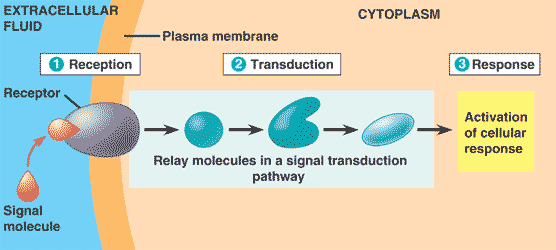
[9] This diagram shows all three stages for cell signaling.
There are also different types of cell signaling, both intracellular signaling and intercellular signaling.
Autocrine signaling is where a cell will send a signal to itself. Contact dependent is when a cell will send a signal to a cell connected by a gap junction. Paracrine is where a cell will send a signal to a nearby cell, and finally endocrine is where a cell will send a signal to a distant cell via the bloodstream.
This is demonstrated in the table to the right. [10]
Integrins, which are involved in cell adhesion, facilitate communication between the cytoskeleton and the extracellular matrix. This allows them to influence the orientation and structure of one another.
{4}{5}

Cell communication is very important once a biomaterial has been implanted.
First, when a biomaterial is implanted, proteins bind to the surface of it. Then due to the damage the implantation process creates, white blood cells migrate to the area. The attracted macrophages then bind to the surface proteins and then signal more macrophages to the area. The macrophages communicate with one another to bind across the whole biomaterial, creating a foreign body giant cell (FBGC). The FBGC sends signals out to attract fibroblasts. These bind to the FBGC in layers to create a granuloma around the biomaterial.

[11] The image above shows the process in which macrophages will surround the biomaterial and form the FBGC.