Materials
How do cells adhere to materials?
How do cells adhere to materials?
Cells will adhere to biomaterials through adhesion proteins (such as cadherins and integrins). These proteins will have specific cell receptors, that are attached to the cell membrane, and these attach to the biomaterial. Biomaterials are often coated in a substrate surface, which then vitronectin coats. The vitronectin has GAGs (glycosaminoglycans) and cell receptor binding sites which promotes focal adhesion.
Focal adhesion is the name for cell binding which forms the mechanical link for cells to the ECM (extracellular matrix) via actin filaments. They will also connect to materials via the actin filaments, where the filaments terminate.
Cells also need to adhere to each other around the biomaterial. They will adhere to each other and the ECM via the cell adhesion proteins, which are on the surface of the cell.
There are different types of cell junction types that allow for cell adhesion, such as focal adhesion, hemidesmosomes, desmosomes and the adherens junction.
Focal adhesion and hemidesmosomes have the strongest adhesion as the cells both use integrin as their adhesion proteins.
{1}{3}


[4] This image show what a desmosome looks like. You can see how the cadherins link the two cells together.

[6] This image show what an adherens junction looks like. Again, its very similar to the desmosome, however it has actin filaments instead of intermediate filaments.

[5] This image show what a hemidesmosome looks like. Its similar to the desmosome, however it links via integrin and to the extracellular matrix instead.
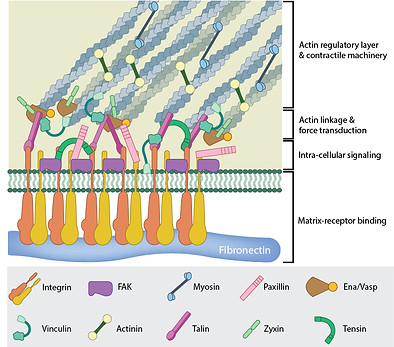
[7] This image show what a focal adhesion looks like. Its similar to the adherens junction, however it uses integrin adhesion proteins instead.
Example of how cells adhere to a biomaterial:
Scaffolds are often used in tissue engineering and are usually made of biomaterials such as synthetic polymers (eg poly-l-lactic acid PLLA), or natural polymers such as collagen or proteoglycans. These scaffolds act as a template for new cells to grow on, or they can be used to support existing tissues by keeping them in place. The scaffold must be biocompatible so that cells will adhere to it, and also proliferate. Scaffolds are often porous which will encourage adhesion. Natural polymers are better than synthetic polymers as they are biologically active and so cells will adhere to it much more easily.
{6}

[8] This is an SEM image of a collagen scaffold. You can see how the gaps between the collagen would allow cells to move and adhere around the scaffold.
What characteristics of a material are favorable?
Materials also have favorable characteristics just like cells. The roughness of the material is one of them. The rougher the surface, the higher the adhesion of cells, however, the smoother the surface, the more blood compatible the material will be.
Pore size will also effect cell adhesion. The larger the pores, the more likely that a severe foreign body reaction will occur. However, the smaller the pore size, the poorer the adhesion, meaning that a pore size between 1 and 2 micrometers is best.
Hydrophilic surfaces are better than hydrophobic surfaces on materials because a hydrophobic surface can prevent adhesion proteins from binding to the surface of the biomaterial. {2}
For a lot of these characteristics, it depends on where the biomaterial is being implanted, so you need to then select the material with the most optimal characteristics for that area. For example for cannulas and needles, which will go into blood vessels, you do not want cells to adhere to the surface of them, which is why needles have such a smooth surface to prevent this from occurring.

[2]The image above shows how a cannula is inserted into the body. As cannulas are usually not in the body long term, you do not want cells to adhere to the surface of it, as this could prevent it from being removed, or it could block the blood vessel that it has been inserted into, or it could even cause a blood clot.